“I am tired, I don’t know where else to go”. The story of a man with an intellectual disability rescued from Russian occupation
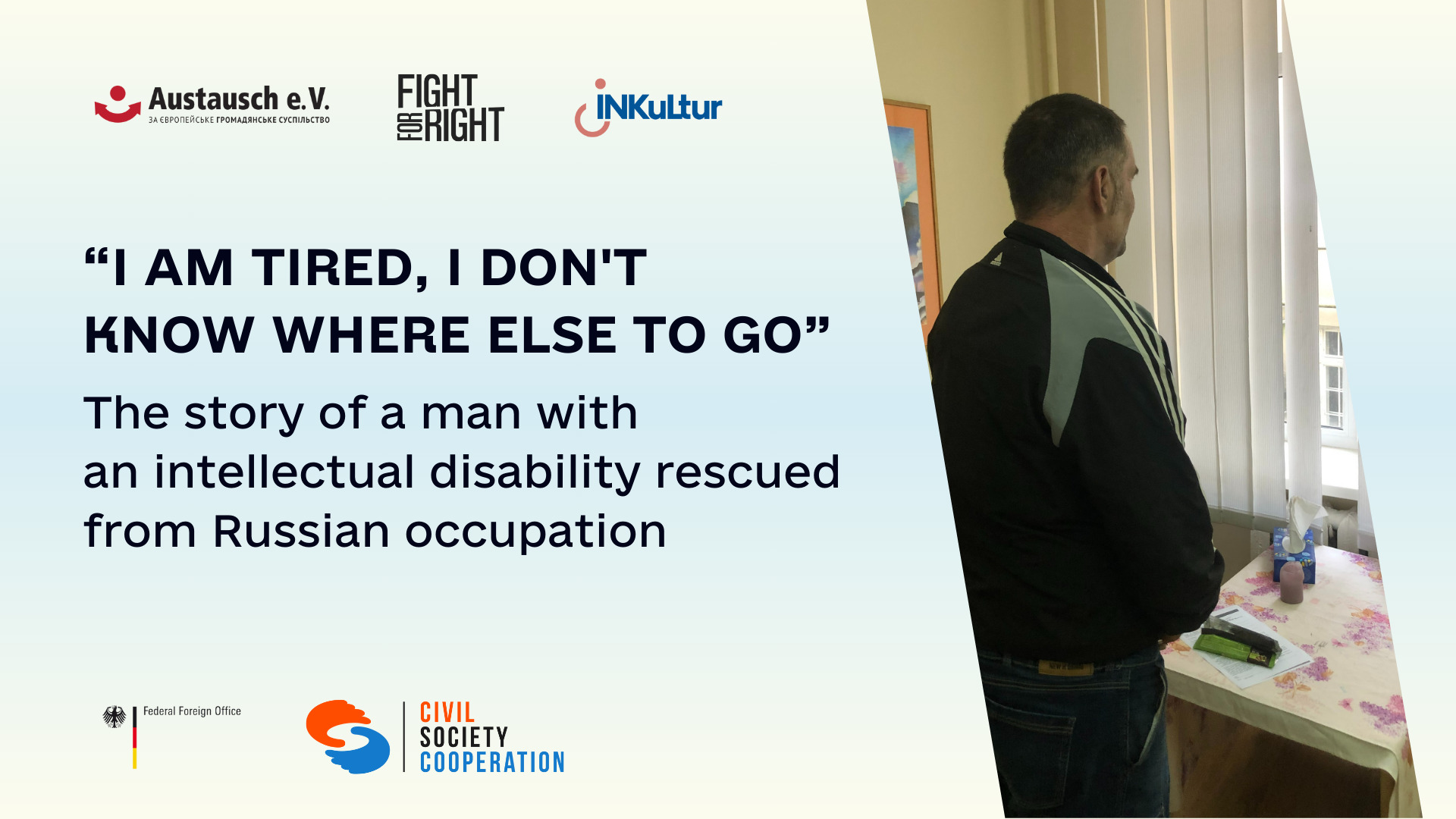
I met Oleksii, a resident of a shelter for internally displaced persons (IDPs) in Lviv in autumn 2023. My colleague and I monitored city shelters for accessibility to people with disabilities as a part of the Fight For Right project.
During the monitoring, I caught the interested look of a middle-aged man. So, we started talking, exchanged a few words. Oleksii shared that he was evacuated to Lviv from the occupied town in the Zaporizhzhia region, has been living in this shelter for over a year, and has a disability because of a childhood head injury.
We agreed to meet again and discuss Oleksii’s life and escape from the Russian occupation in more detail.
So, we met again in November in the same shelter.
Once I arrived, a woman working in a shelter warned me that Oleksii has been depressed and anxious recently, often recalled his deceased stepfather. She was not even sure if we would have that conversation at all.
I was prepared for different scenarios, having delved into the lives of people with intellectual disabilities for several years. Following Russia’s full-scale invasion of Ukraine, I began documenting the wartime experiences of people with disabilities. These scenarios could involve a declined interview, an abruptly interrupted conversation, or conversely, a genuinely heartfelt and detailed story. The very first responsibility of those recording these experiences is to ensure they do not cause harm to the individuals involved.
I met Oleksii in a big common room he shared with other people who found shelter in Lviv after fleeing the war. He was waiting for me, ready to talk.
“He would grab and hit me.”
Oleksii is not sure about his age, but he knows exactly that he was born and spent the first years of his life in Zaporizhzhia.
During our conversation, Oleksii often mentioned his father and stepfather. He clearly described how different they were and how differently they treated him.
The father hit Oleksii when he was really young. He recalls father hitting him on the head:
“He would grab and hit me. I felt blood pouring from my ears, my nose, and my head. My speech turned bad and stuttering.”
Spontaneously, a rhetorical question arose:
“Could intellectual disability have resulted from early-life physical abuse?”
Oleksii’s parents divorced after a while and his mother remarried. The family moved to a town in Zaporizhzhia region. Oleksii’s stepfather gave him love and support.
Oleksii helped both his parents and neighbors with household chores, tending to livestock and poultry, cultivating vegetable gardens, and earning compensation for his efforts.
“It got dangerous there, katsaps settled down in town.”
In early March 2022, Oleksii’s hometown was occupied by Russian troops. Some residents chose to collaborate, and Oleksii openly criticized them, thereby exposing himself to potential danger. More than that, invaders began to steal from locals or destroy their property.
Oleksii witnessed the murder of a civilian by Russian invaders:
“Here they (auth. Russian military) drive, and he shows his finger to them, just like that…So the Russian soldier pulls his gun out and “boom!” Shoots him right in the forehead. He kicked the bucket at once.”
It was after this incident that the man decided to leave the occupied town. He tried to convince his mother go with him, but he failed. So, he set out on his own taking only money with him. Moving through the woods, he passed tripwires and found himself near the Russian checkpoint:
“The Russian soldier got out of a car, came up to me, pulled his gun out, and put it to my head. He was holding me doing “Too-o-o-o”. That’s how he tried to scare me. And then he would say: “Get down on your knees! What’s there in your pocket?” I had some cash for a trip and a banking card… But I was smart, you know, I hid everything in my socks (laughing). Who the heck knew where they’d be looking.”
After a while, Oleksii managed to get into the territory controlled by the Ukrainian military. They contacted volunteers who evacuated Oleksii to Zaporizhzhia. Oleksii remembers trembling with fear and stress throughout the journey to Zaporizhzhia:
“I came to Zaporizhzhia, my whole body shaking. I was absolutely terrified. Maybe God saved me, maybe my late father watched me… Maybe he was the one who saved me…”
Looking for a safe place
After a few days in Zaporizhzhia Oleksii realized that the city was under continuous attacks, so he needed to find a safer place. He left for Lviv, supported by the same volunteers.
Oleksii says that he arrived to Lviv in spring 2022 and immediately settled in a shelter. He speaks very warmly about his current accommodation, people around him, living conditions, food, and the feeling of being useful to others. Oleksii oversees garbage collection, takes kitchen shifts, and tries to help the shelter personnel with chores.
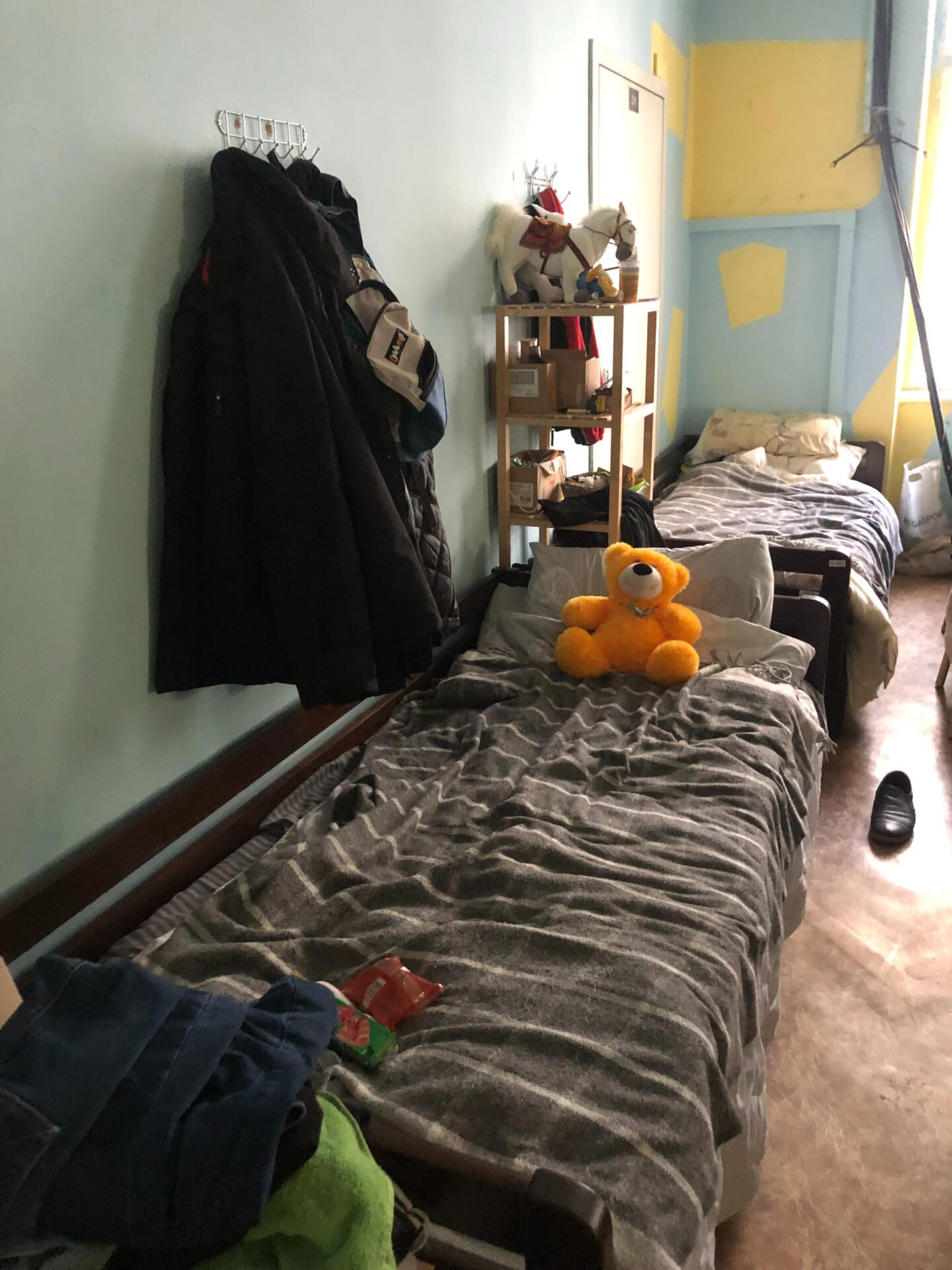
Photo by the author. Oleksii’s sleeping place in the shelter.
Oleksii really wants to find a job as a janitor in Lviv to rent a room and buy things. Now he cannot afford new clothing, additional food, or occasional attractions.
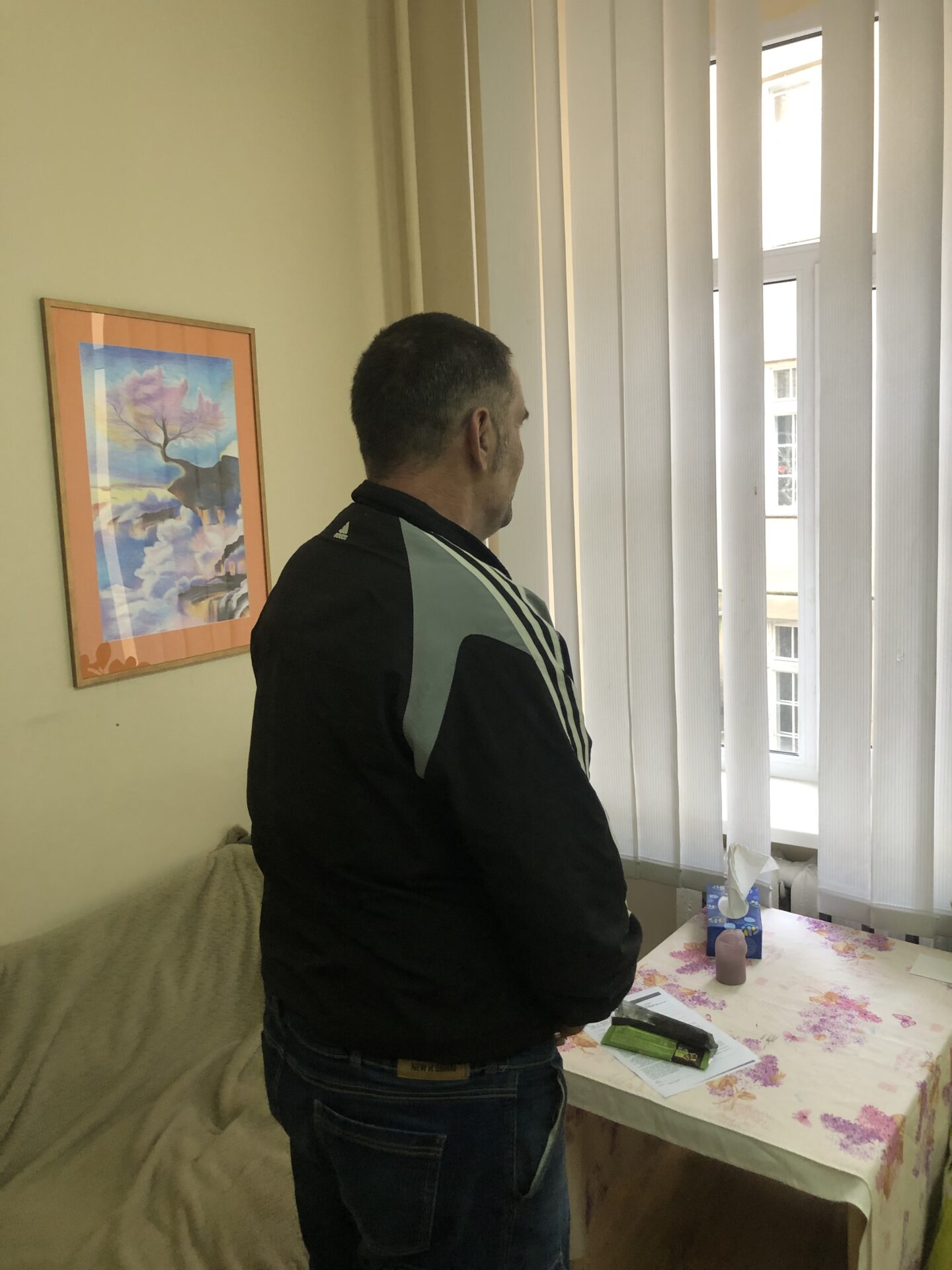
Photo by the author. Oleksii
Oleksii’s rescue story is an example of the proactive attitude of a person with intellectual disability during a war or life-threatening events. He was strong enough not only to try and escape occupation but also to think over the logistics and find people who helped him to adapt to a new place.
The firsthand experience of living independently in a shelter can serve as an illustrative example for comprehending the autonomy of people with disabilities. Administrations of compact residences for internally displaced persons (IDPs), especially those with disabilities, should explore the option of establishing support services or assistants for their residents. These services could aid in adapting to new living environments, facilitating socialization, and assisting in the search for employment.
***
This conversation was important to me as well. Oleksii’s example dispels the myth that people with intellectual disability are only victims of war, vulnerable non-subjects during military conflicts, disasters, and cataclysms.
Oleksii’s experience during Russia’s full-scale invasion in Ukraine highlights the distinct challenges faced by people with intellectual disabilities and their varied contributions in the collective effort against the enemy.
The project “Barrier-free Safety for People with Disabilities” is the part of INKuLtur-Programme implemented by Austausch e.V. together with Eastern Partnership countries funded by the German Federal Foreign Office.
#CivilSocietyCooperation #BarrierFreeAccess #INKuLtur
Author: Hanna Zaremba-Kosovych,
researcher of disability studies