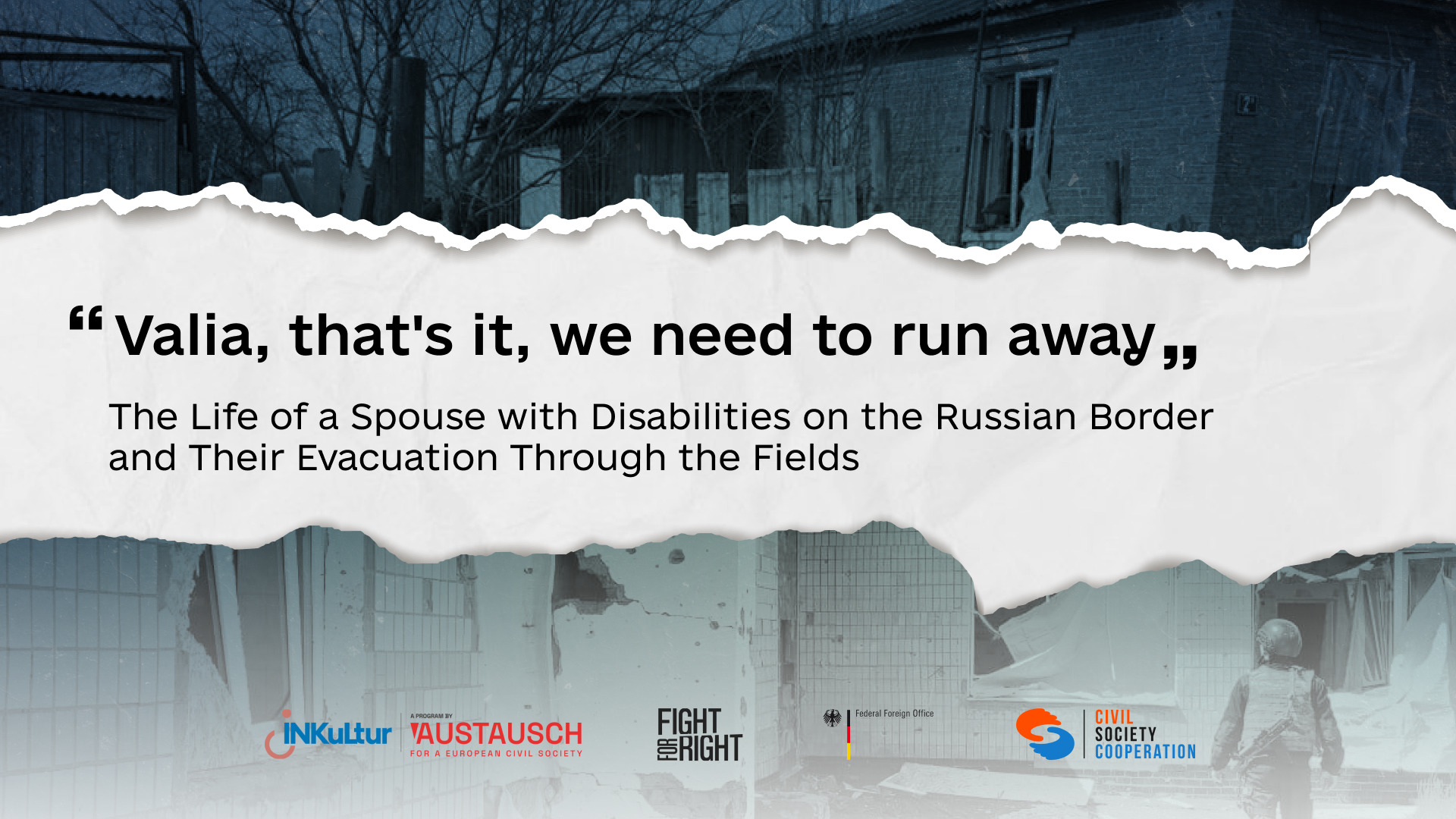
“Valia, That’s It, We Need to Run Away”: The Life of a Spouse with Disabilities on the Russian Border and Their Evacuation Through the Fields
The Vovchansk community chat is now filled with messages like, “Does anyone know where (names) are? Please write to me. Any information is important.” And while scrolling through other messages, you freeze: “Are they alive? Where are those people? How are they now?”
For the second month now, residents of Vovchansk and the surrounding villages have been gathering information about their relatives, friends, and neighbors from everywhere. People connected by one calamity find solace in communicating with fellow countrymen who understand, like no one else, the hell they have to go through. After the repeated Russian attack on Kharkiv region in May of this year, the Vovchansk community suffered huge losses. The scourge of war still hasn’t receded and continues to tear people’s lives apart…
Thousands of families were forced to leave their homes, some for the second time, because, after the liberation of Kharkiv Oblast from occupation in the fall of 2022, they had gladly returned home from evacuation. For others, it was the first time, like the family of 67-year-old Valentyna and 70-year-old Anatolii (names changed for ethical reasons) from a village near Vovchansk.
Our Fight For Right team met this elderly couple in one of the hostels in Kharkiv, where Valentyna and Anatolii had temporarily settled after being evacuated on May 12.
Evacuation was difficult for both, psychologically and physically. Currently, Anatolii is attempting to handle all matters (such as registering as an internally displaced person, opening accounts, etc.) for both him and his wife, despite the considerable effort it requires, as he only walks with a cane and a crutch. Valentyna can hardly move after the evacuation; her health has greatly deteriorated. Transporting someone with a compression fracture of the spine, like Valentyna’s, is risky under any conditions, let alone navigating off-road through fields under fire.
What was the biggest challenge for Valentyna and Anatolii as elderly people with disabilities during Russia’s war against Ukraine? Why do they, like hundreds of other people, not register their disability? We talked about this with them on a warm summer evening in Kharkiv, interspersed with air raid alarms…
“We were occupied at once”
The village where Valentyna and Anatolii lived is only 7 kilometers from Vovchansk and a few kilometers from the border with Russia. On February 24, 2022, their son woke them up with alarming news: “The war has begun! Tanks are coming.” Anatolii recalls that all the equipment the Russians had gathered near the border for a full-scale invasion was moving down the street past their house in columns.
“I counted and counted. I counted 78, then stopped… Russian military vehicles kept going and going,” adds Valentyna. “No one expected that Russia would do such a thing.”
True, the capture of the village by the enemies in 2022 did not bring as much grief as it does now. Leaving several hundred occupiers in the village, the rest of the Russian army then moved further into the Kharkiv region.
“We were occupied at once. They (the Russian military – ed.) were masters here, they used their authority, going from house to house. Where there were no people, locks were broken, and everything was stolen. However, we were not directly affected then. We just didn’t have anything to eat. Supplies ran out, we ground wheat to bake bread, but there was no yeast… It was scary,” Valentyna says with a sigh.
Valentyna and Anatolii’s children and grandchildren, along with their families, left for Europe almost immediately through various means to avoid remaining under occupation. This is what almost all young families did, saving their children. Most of the people left in the village were older people who didn’t dare to leave due to their health or fear of seeking shelter in a foreign land.
Valentyna and Anatolii thought for a long time about what to do, but due to their health, they never made the decision to leave. And when the occupiers were driven out of the Kharkiv region, they dreamed that soon the war would end, and their relatives from abroad would return home, hug them, and share their adventures, and life would return to normal.
It was comforting to think that as long as both houses – the daughters’ and theirs – survived, they could return and resume their chores around the house. However, the restless border area, where our defenders caught subversive intelligence groups, and the constant threat of a new offensive by Russian troops, kept their loved ones from returning from abroad all the time, just like other families in the village.
“It was possible to live there”
After the de-occupation of the Kharkiv region in September 2022, Valentyna and Anatolii were primarily supported by relatives and neighbors. So, during these years, they managed to do chores and take care of their two favorite dogs – an Alabai and a Pekingese.
Thanks to volunteers and humanitarian aid, the family had everything necessary for life during the full-scale war.
“We didn’t need a social worker. Humanitarian aid was provided every month – both food and hygiene kits. Volunteers brought bread every Tuesday. The pension came steadily. The store was working. So it was possible to live there,” Valentyna says.
“We were always at home,” Anatolii adds. “I would only start the walk-behind tractor to go to the village council to collect humanitarian aid and our pensions, and then come back.”
Despite the village being without gas, the power supply was restored. In case of power outages, the family purchased and used a generator. So, Valentyna and Anatolii were constantly in touch with their relatives. Already abroad, they had a great-granddaughter, and daily video calls, stories about what the little one learned, became a consolation for the couple.
At the same time, several families who fled the occupation at the beginning of the full-scale invasion even returned to the village.
“Some people came, at least to plant gardens, hoping they would be able to harvest under a peaceful sky. Everything has already grown… And now…” Anatolii sighs and pauses in the middle of a word.
“When they started shelling, we could already determine by the sounds what was shooting and where it was flying”
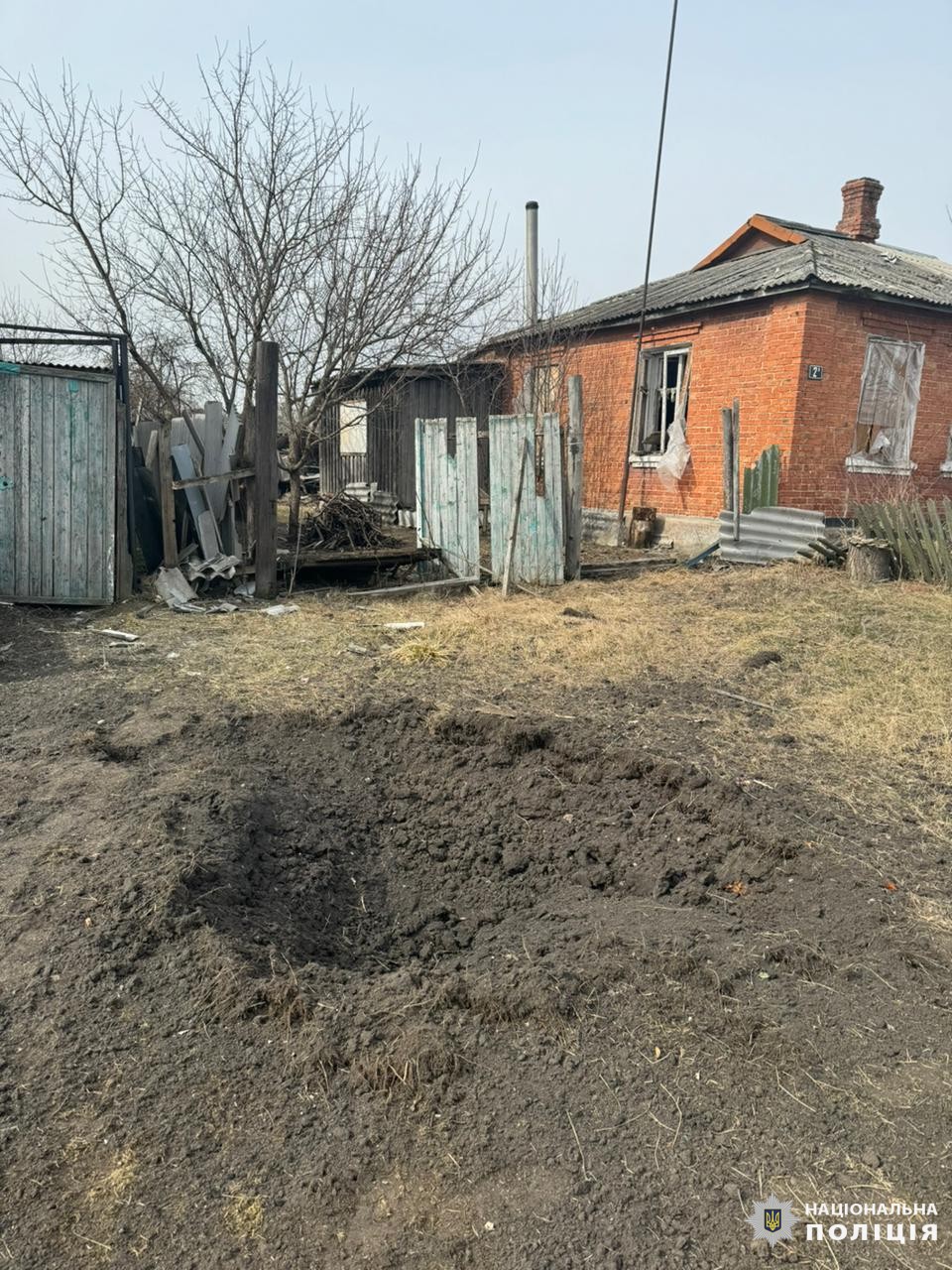
In late April of this year, as the Russian army began mercilessly bombarding the Kharkiv region with aviation and artillery, residents of the Vovchansk community were once again forced to leave their homes to seek safety. Even those who did not dare to leave due to their health, like Valentyna and Anatolii, were already seeking salvation.
“The cultural center was destroyed, half of the new school lay in ruins, the kindergarten closed down, and even the store shut its doors… Russian drones circled overhead like rooks. We couldn’t even go through the yard because it might have contained unexploded ordnance… One woman ventured into the garden, and an explosive was thrown at her… That woman died… They (the Russian military – ed.) seemed to be enjoying themselves… It’s terrible what happened. Ammunition could be dropped from a drone onto civilian vehicles just like that. When they started shelling, we could already determine by the sounds what was shooting and where it was flying. So many houses were bombed on our street… There are no windows or doors left in my daughter’s house. That house was new; we tried to do everything as best as possible, in a modern way,” Anatolii recalls with pain.
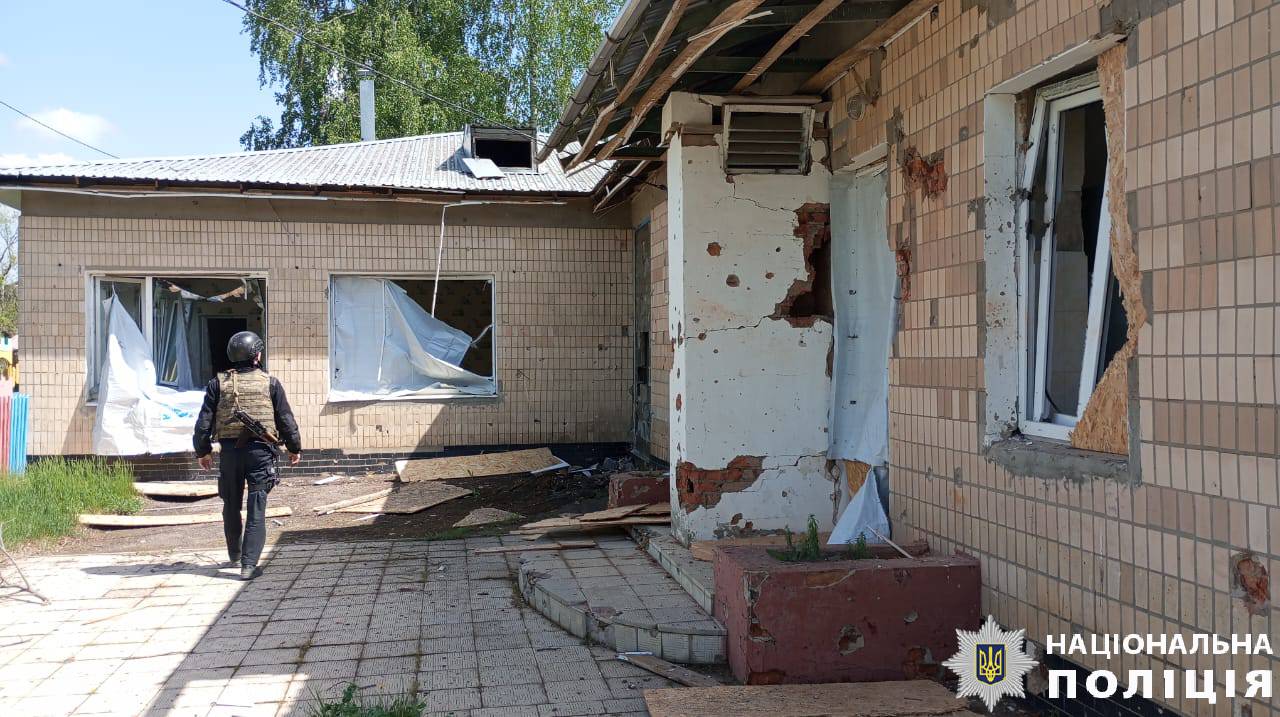
The Russians bombed the Vovchansk community especially mercilessly from May 9 to 10.
“Although I was opposed to leaving,” Anatolii sincerely admits, “but when I saw what they were doing to us, I said, “that’s it, Valia, let’s run.” “We immediately called 102.”
Hours and days of waiting dragged on because evacuating under shelling is an extremely difficult task. In addition, just like Valentyna and Anatolii, hundreds more families in the Vovchansk community, including people with disabilities and the elderly, dreamed of escaping the shelling. On the third day, two vehicles arrived, and Valentyna and Anatolii quickly got into them and drove straight across the fields, fleeing from pursuit by enemy drones.
“Unfortunately, we couldn’t take our dogs with us then,” Valentyna says sadly. “We only took a few personal belongings. But we made an agreement with our neighbor who stayed in the village that he would take care of them, feed them.”
“We have a disability without a certificate”
Upon arriving in Kharkiv, Valentyna and Anatolii were offered a room in a hostel on the second floor, where they were helped to settle in and get comfortable. Volunteers provided everything they needed and still come by to ask if they need anything, offering help, including the Fight For Right organization in particular. There are medical professionals who provide consultations directly to internally displaced people in such temporary shelters. Although the family is grateful to everyone for their care, they do not take it for granted.
“We had all the amenities, water, and we had a two-story house; we had everything for a comfortable life… We had been building that for years. Everything remained there. We came here with three bags.” Anatolii says.
“We don’t belong here in the hostel. We’re not used to being “babysat” in such conditions. I hope our children will find us separate housing. But for now, we’re here because we’re not healthy and still need treatment,” adds Valentyna’s husband.
Daily work took a toll on their health; they used to be hardworking people. In his youth, Anatolii was a driver for a local agricultural enterprise, while Valentyna worked at an embroidery factory in Vovchansk. Later, they started growing vegetables, built greenhouses at home, and sold their produce in Vovchansk and Kharkiv.
But for the past ten years, it has been hard for Anatolii to walk without assistance.
“They offered to perform surgery (joint replacement) costing more than UAH 140,000. But where would we get that money if our pension is only 2,800? Neither my wife nor I filed for disability because it’s too much trouble; we would have to go from hospital to hospital… And the payments are just as small. So we don’t want to do that,” Anatolii explains. “When they say, “give us a disability certificate,” I answer that we have a disability without a certificate.”
Valentyna’s health deteriorated significantly in the fall of 2023.
“I had such painful “shots” in my back that I wanted to scream. In a moment, my health failed, and that was it. The tomograph was done as prescribed by the doctor. The doctor’s report states that there was a compression fracture of the spine, and on top of that, I have arthrosis, signs of osteochondrosis, spondyloarthrosis, and more. The treatment helped a little, and I walked with a supportive corset. But the off-road evacuation worsened the situation; now I can’t walk, and I can’t sit for long either,” Valentyna laments, and she plans to see doctors in the near future.
***
Many unanswered questions lingered after the conversation: What would motivate evacuating from front-line settlements in advance, under calmer circumstances? Why do people with disabilities wait until the last moment to evacuate, exposing themselves and volunteers to greater threats? Would disabled and older people consider evacuating more quickly if they were confident that their pension or social security benefits would cover their living expenses elsewhere, including rent? Would people with disabilities decide to evacuate more quickly if they knew that any settlement provides architectural accessibility in both apartments and administrative or commercial buildings, allowing them to freely access social, banking services, etc.?
Valentyna and Anatolii are ready to return home right away. “We would go home right away if only we had a place to return to and if there were no shelling,” Anatolii says sadly. First of all, he and his wife would retrieve their dogs from the shelter, where they were placed by animal volunteers at the end of May when the shelling subsided a little.
Meanwhile, every evening Valentyna and Anatolii review messages in the chat room of the Vovchansk community. They are happy that people unite and help each other to obtain necessary Technical Inventory Bureau certificates for property, find doctors or lawyers, rent housing, find free shelters, and secure jobs… But above all, they are worried about their acquaintances with whom they have lost contact, and they are searching for news about them.
Time after time, reminders pop up in the chat feed not to disclose the addresses of people waiting to be evacuated, but to submit applications through official channels like 102 or through verified volunteer organizations. There were cases when pseudo-volunteers took people to Russia.
The Fight For Right team, for its part, encourages people with disabilities and the elderly to evacuate from front-line settlements. We are ready to provide comprehensive support for this endeavor.
If you need help, please send your request and information about yourself to help@ffr.org.ua or call the Fight For Right hotline at 0-800-30-66-33.
The project “Barrier-free Safety for People with Disabilities” is the part of @INKuLturProgramme implemented by @Austausch e.V. together with Eastern Partnership countries funded by the German Federal Foreign Office.
#CivilSocietyCooperation #BarrierFreeAccess #INKuLtur
Authot: Iryna Dovhal